



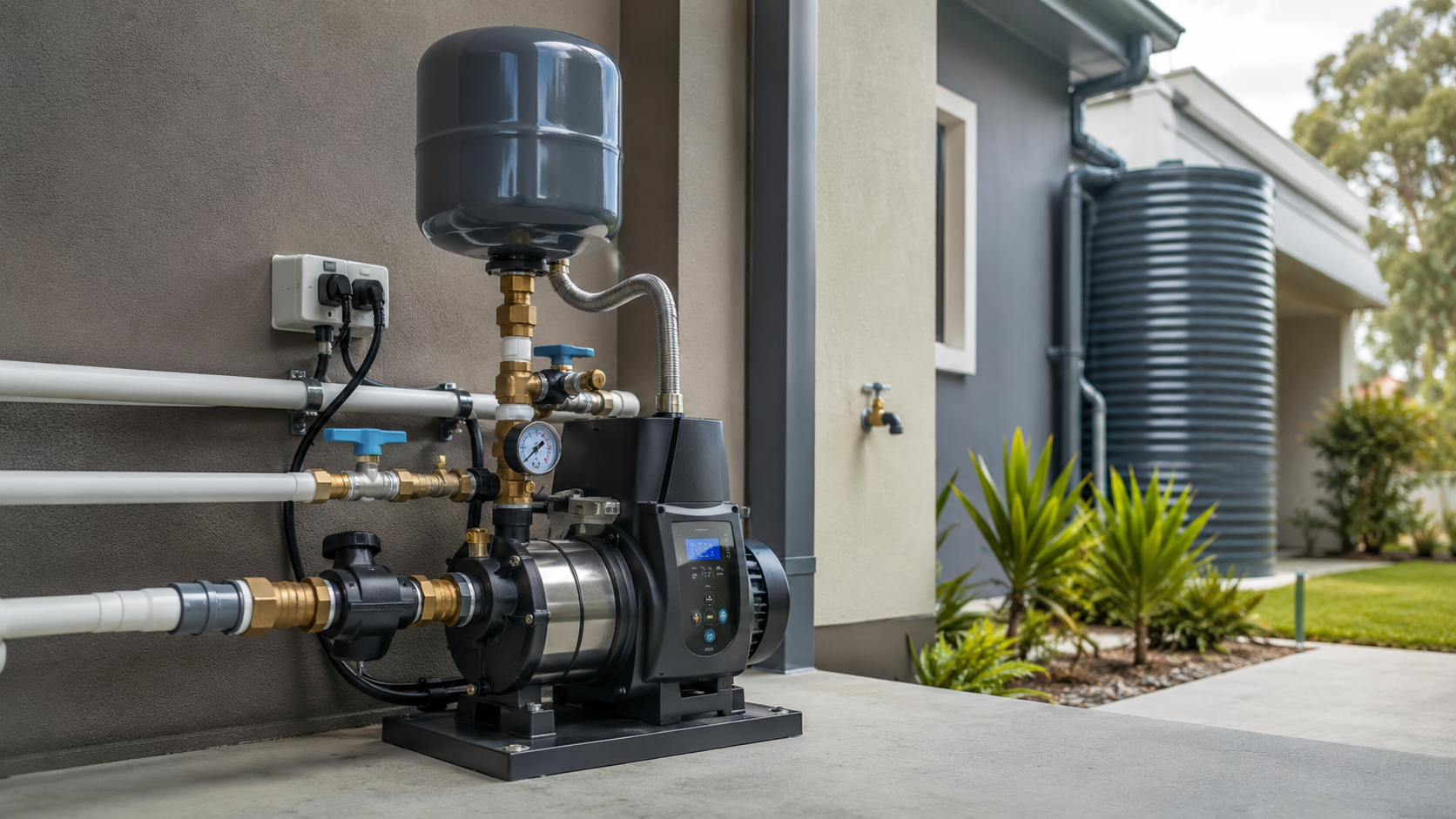
Understanding Variable Speed Pumps: How Modern Technology Is Changing Residential Rainwater Systems
A rainwater tank is a storage vessel. That’s it — all it does is store water. Everything else, from pressure to reliability to running costs is determined by what pump is attached to it. That means most homeowners are essentially planning half a system and then declaring it done.
The tank gets all the love, the pump does all the work
When talking about water tanks, catchment area, tank size, first flush, and filtration generally dominate conversations. While all of this contributes significantly to the performance and value of a tank system, none of it contribute to the pressure characteristics of the water it produces. That’s the domain of the pump.
A tank is a passive device; it stores water but doesn’t do much else. The pump does the heavy lifting, regulating pressure and determining whether a home will have adequate supply or all the benefits of a tank and the headaches of inadequate pressure. Get the pump wrong and you can have the best tank in the world, but water that surges out at an alarming rate, regularly drops to a trickle, or causes the pump to cycle wastefully on and off. Get the pump right, and it can all but vanish from daily consciousness — the very definition of a well-chosen pump.
Why single-speed pumps are doomed to fail in the face of domestic demand
Pumps operating at a single speed generally operate at a single pressure and flow rate — unless demand from fixtures and fittings dictates otherwise. Opening a single tap causes them to ramp up to full speed to satisfy the demand. Leaving that tap open a fraction causes them to cycle wastefully on and off in an attempt to satisfy the reduced demand. This can cause enormous pressure spikes downstream, and is the source of water hammering — the knocking and thudding heard in pipes when a valve somewhere is closed rapidly.
It may seem like splitting hairs, but in the context of a home and the demands it makes on a pump — including the ability to run multiple fixtures at once — single-speed fixed pressure systems are problematic in several ways.
Water hammer aside, single-speed pumps are notoriously bad at coping with multiple simultaneous demands. One tap is fine, but add another and you’ll notice a drop in pressure at the first. Add a third and the drop becomes a noticeable reduction — and the whole system becomes an exercise in frustration. It’s this characteristic that sees many rainwater systems earn the reputation of ‘poorer than mains.’
How a variable speed pump fixes everything
A variable speed pump is not fixed to a particular speed — it varies the speed according to demand. A pressure transducer fitted to the system constantly monitors the pressure and relays this information to a variable speed drive (VSD), an electronics module which causes the pump to slow down or speed up in response to changes in pressure.
Opening one tap causes the pump to accelerate until it reaches the desired pressure, and then maintain that pressure as set by the user. Opening a second, third, and perhaps even a fourth all at once causes the pump to continue accelerating, until the desired pressure is reached across all open outlets. This could mean a shower, a tap in the kitchen, a washing machine, and a lawn sprinkler all at once. Whatever the case, the pump reaches the required pressure and maintains it, uninterrupted and without spikes or drops in either pressure or flow rate — regardless of how many outlets are open.
The fundamental difference is that rather than a pump which is either on or off, you have one which is constantly varying its speed to satisfy the demand. It’s the domestic equivalent of a dimmer switch rather than a light bulb — it doesn’t just meet demand, it tracks it constantly and instantaneously.
The energy savings of a variable speed pump: it really is all about the physics
The reason for the energy savings is simple physics, and it’s best expressed in the affinity laws.
The affinity laws dictate how changes in speed affect the performance characteristics of a centrifugal pump — and it’s especially relevant to the power consumption. Simply put, power consumed is related to the cube of speed changes. So if you reduce the speed of a pump by half, the power required drops by a factor of eight. There’s your energy saving.
It’s not hard to see why a variable speed pump would consume less electricity at any given point than a fixed-speed pump. The question then becomes how much time is spent at any particular speed, and the answer is right there in the physics. A fixed-speed pump has to operate at full speed, consuming full power, to satisfy peak demand. Peak demand rarely lasts for long, and average demand is significantly lower. Variable speed pumps are able to reduce speed during periods of lower demand, and because of the cube relationship this has a disproportionately large effect on power consumption. The overall result is a dramatic reduction in energy use across the board.
The soft-start advantage: not as important as it sounds, but still beneficial
A mechanical advantage inherent to variable frequency drive (VFD) pumps is a soft start — they do not accelerate from 0 to full speed instantly. At the beginning of a start cycle, frequency is gradually increased — and in doing so the current required is far lower than it would be for a fixed speed pump.
Electrically, this means the windings of the motor are not subjected to the same kind of stress they would be for a fixed speed pump. Hydraulically, it prevents pressure spikes and water hammer — the same kind of effects seen at the end of a single-speed pump cycle. It may seem a minor difference, but the cumulative effects of reducing stress on the motor and hydraulic system can have a major impact on service intervals and reliability. Fewer elbows failing, fewer callouts due to faulty electrical connections — it all adds up.
Peak demand versus average demand — and why most rainwater installations are undersized
When designing or upgrading a rainwater system, one of the most common mistakes is to size it according to average demand, not peak demand.
Average demand says little about what a pump needs to do. What matters is the peak concurrent demand; that is, the combined flow rate of all the outlets being used at once. That value is generally two to three times what average demand suggests, and it dictates the pump sizes necessary to satisfy that flow rate while maintaining pressure.
Once you have flow rate requirements, it’s a matter of selecting the right pump based on a combination of pressure and flow rate. Pumps are generally sized to a certain flow rate against a certain pressure, so it’s a two-variable problem. Most domestic applications would use a multi-stage centrifugal pump with a VSD — the former providing additional head, and the latter modulating motor speed to control flow rate and maintain pressure. This really requires working with pump curves, which is generally best left to people who do this for a living. That said, there are plenty of resources for homeowners who want to calculate their requirements, and Shenton Pumps can help match them to a particular pump or variable speed inverter.
How not to get sabotaged by the pipe: sizing and losses
There are few things more frustrating for a homeowner than getting the perfect pump recommendation, only to discover that the pressure at the tap is far below expectations. More often than not, it has little to do with the pump and everything to do with the pipe. The two variables which must be considered when discussing total head and pressure loss are the static lift and friction loss.
Static lift is simple: it’s how far the pump has to lift the water. If the tank is low to the ground and the shower is upstairs, the static lift is considerable. Friction loss, on the other hand, is a function of the size, length, and fittings of the pipe. A smaller pipe, more fittings, or a longer pipe will all cause pressure loss — sometimes up to 30% in extreme cases. While a good pump will compensate for some of that loss, it can only do so much. Inadequate pipe sizing will always be a limiting factor on pressure, even with a good pump.
Using a pump as a monitoring device, not just a water-pumping device
Modern VSD pumps are increasingly connected, with smartphone apps letting users keep track of how much the pump has run and how much water has passed through it. Some offer leak detection functionality, allowing the user to know when something is wrong. Dry-running protection is often standard, which can shut the pump down when there is no water present to prevent damage to the pump.
It’s all part of a bigger trend which sees the pump as not just a water-moving device, but a monitoring platform which keeps an eye on the system and lets the user know when something is wrong — preferably long before the damage becomes expensive to address. Pumps are also starting to be used as switching devices, with automated switching to mains water if the tank runs dry. It’s a smart way to utilise the increased flexibility of a VSD pump and take full advantage of the monitoring capabilities.
Planning the system in the right order
There’s a reason things get built wrong, and it’s usually because there was no established order in the first place. When talking about rainwater systems, that means choosing a tank size according to the space available, neglecting the pump because it wasn’t considered at the same time as the tank, and letting the installer choose the relief valves, overflow, and other accessories on the day.
It’s far better to create zones of water use. Decide how many fixtures and appliances can be used at once, and then choose tank size and pump size accordingly. From there, it’s a matter of choosing the pump model, considering sump or surface installation, priming, and dry-running protection. Whether the pumps should be inside the tank or in an enclosure beside it is all part of the process, and it all comes down to having the right sequence.
With the pump as the focal point, it dictates how the tank should be sized, and then the accessories selected to complement the two. With the shifting demographics and water restrictions tightening by the day, a tank-and-pump system is generally a good way to go — and a variable speed pump is a must if you want to make the most of what you’ve got.